
In 2025, the world continued to witness intense strategic competition among major powers, an increasing tendency to address issues through escalation and the use of force, along with prolonged and expanding military conflicts in many regions. Nevertheless, peace, cooperation, and development remain the major trends and shared goals. To provide a comprehensive overview, the National Defence Journal compiles and presents ten major military and defence events worldwide in 2025.
1. The US releases its new National Security Strategy
On 5 December 2025, the administration of US President Donald Trump officially unveiled a new National Security Strategy, introducing major changes guided by the “America First” principle. The strategy rejects the ill-fated concept of global domination for itself, while preventing the global, and in some cases even regional domination of others, which does not mean wasting blood and treasure to curtail the influence of all the world’s great and middle powers. The new strategy significantly narrows the scope of issues that Washington defines as "core, vital national interests" and prioritises border security to end the era of mass migration, the development of domestic industries and core technologies such as energy and artificial intelligence, the strengthening of military power, and the building of the “Golden Dome” missile defence system to protect the US. The strategy also emphasises economic competition with China and redefines relations with allies, especially in Europe, adopting a more pragmatic approach to security issues, and underscoring greater burden-sharing from allies, etc.
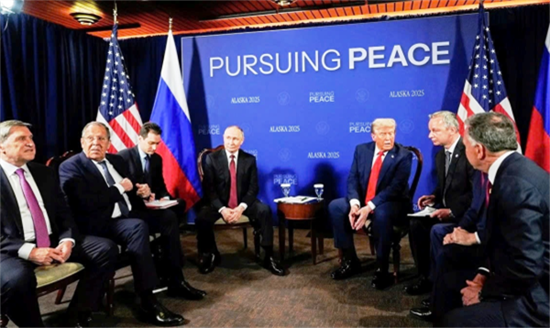 |
| Alaska Summit between Russia and the US on 15 August 2025 (photo: baochinhphu.vn) |
2. The Russia - Ukraine peace process faces ongoing challenges
After numerous diplomatic efforts, the US and Russia agreed to several basic conditions to end the Russia - Ukraine conflict at the Alaska Summit on 15 August 2025. However, due to a lack of consensus among the leaders of several European Union (EU) member states and Ukraine, US President Donald Trump directed adjustments to certain provisions of the agreement and put forward a 28-point peace plan. Accordingly, Russia, Ukraine, and Europe will conclude a non-aggression agreement; Ukraine will constitutionally commit to not joining NATO but will receive reliable security guarantees; Russia will be reintegrated into the global economy; Crimea, Luhansk, and Donetsk will be recognised as de facto Russian. Meanwhile, the EU proposed a different 24-point peace plan containing many provisions largely at odds with the US proposal. The Kyiv administration, for its part, stated that it would not accept any agreement that forces Ukraine to relinquish its territorial integrity or prevents it from joining NATO. As a result, the Russia - Ukraine peace process continues to face numerous challenges, and fighting between the two sides on the ground remains intense.
3. The 12-day war between Israel and Iran
Following the escalation and spillover of conflict in the Middle East between Israel and Iran-backed armed groups, the 12-day war between Israel and Iran, particularly with the direct involvement of the US through sudden airstrikes on Iran’s nuclear facilities, reflected a major shift in the region’s strategic landscape. This marked the first direct military confrontation between two hostile regional powers in the Middle East. Compared with previous Middle Eastern wars, the Israel - Iran conflict was limited in scale and scope; however, its consequences are expected to continue shaping the Middle East strategic landscape for many years to come. Militarily, the conflict reaffirmed Israel’s overwhelming superiority, especially with the support of its ally, the US. Politically, the war further deepened the irreconcilable contradictions between the Jewish State and Iran, while also illustrating a growing trend towards the use of force as a means of resolving disputes, both in the Middle East and globally.
4. The ceasefire agreement in the Gaza Strip
On 9 October 2025, the Israeli government and representatives of Hamas confirmed that the two sides had signed a first-phase agreement on a ceasefire in the Gaza Strip and a hostage exchange. This marked the first step in a broader plan to bring an end to hostilities in Gaza, with US President Donald Trump acting directly as the mediator. The ceasefire agreement represents a symbolic breakthrough towards ending a conflict that has lasted for two years. On 17 November 2025, the United Nations Security Council adopted a US-drafted resolution endorsing President Donald Trump’s 20-point plan to halt the fighting, which includes the establishment of a new international transitional body, the "Board of Peace", and the development of a temporary international stabilisation force in the Gaza Strip. However, Hamas rejected this mechanism, while the Palestinian Authority expressed support for its implementation. This document has also sparked controversy within Israel, as it refers to the future establishment of a Palestinian State. According to political analysts, the practical implementation of this resolution is likely to face significant challenges in the period ahead.
5. The Cambodia - Thailand border conflict
On 28 May 2025, the Cambodia - Thailand border conflict erupted as a result of the long-standing dispute over Preah Vihear Temple, a heritage site that has remained unresolved for centuries. Members of the United Nations Security Council agreed to support ASEAN in playing a leading role in mediation, rather than intervening directly through a binding resolution. US President Donald Trump warned that the US would impose high tariffs on both countries if they refused to come to the negotiating table to end the conflict. Due to US pressure and Malaysia's mediation - ASEAN’s rotating Chair in 2025 - Cambodia and Thailand entered negotiations and reached a ceasefire agreement. The agreement was formally signed on the sidelines of the 47th ASEAN Summit held in Malaysia on 26 October 2025. However, in early December 2025, the Cambodia - Thailand border conflict flared up again, with both sides accusing each other of provoking hostilities. This time, the fighting spread across six border provinces, causing heavy casualties and forcing nearly half a million people to evacuate.
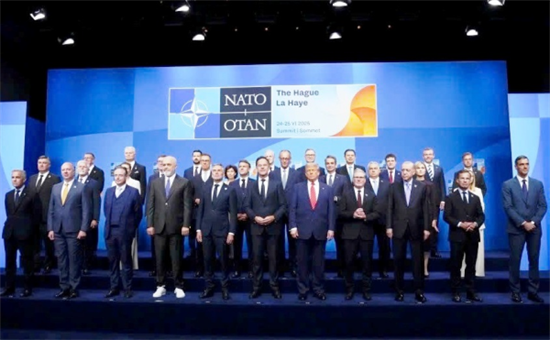 |
| NATO Summit in The Hague on 25 June 2025 (photo: AP) |
6. Escalating US - Venezuela tensions pose the risk of war
According to international researchers, over the past years, the US has consistently pursued a policy aimed at changing the regime of Venezuelan President Nicolas Maduro. During his first term (January 2019), US President Donald Trump recognised Juan Guaido - the opposition candidate in Venezuela’s presidential election as the “legitimate president” and declared that the US did not rule out the possibility of military intervention in Venezuela “to protect the legitimate President Juan Guaido”. Since mid-August 2025, the US has stepped up military pressure on Venezuela under the pretext of “combating transnational drug trafficking”. In addition to conducting airstrikes against vessels allegedly involved in drug smuggling, Washington has deployed an unprecedentedly large force, including full aircraft carrier strike groups, submarines, and combat aircraft, to intensify its deterrence against Caracas. Researchers argue that, besides the goal of combating drug trafficking, the real motive of the campaign is to exert pressure on the government of President Nicolas Maduro, as well as on Venezuela’s allied countries, which the US considers “rogue states” in Latin America.
7. US President announces nuclear testing resumption
On 30 October 2025, ahead of the US - China Summit on the sidelines of the APEC Leaders’ Meeting held in South Korea, President Donald Trump announced that the US would immediately resume nuclear testing, arguing that other countries were conducting such tests and that Washington cannot sit idly by. This move promptly drew widespread international attention and sparked serious concerns among numerous countries and international organisations. Russia swiftly warned that it would take a proportionate response if the US actually restarted nuclear testing. Even some US lawmakers, criticised President Trump’s announcement as “reckless and dangerous”, warning that even a single nuclear test could be sufficient to trigger a new global nuclear arms race.
8. NATO commits to increasing defence spending
Under pressure from the US and amid the increasingly complex developments of the Russia - Ukraine conflict, the 2025 NATO Summit committed to raising defence spending to 5% of GDP by 2035. This increase comprises at least 3.5% of GDP to resource core defence requirements and up to 1.5% of GDP to protect critical infrastructure, defend networks, ensure civil preparedness and resilience, unleash innovation, and strengthen defence industrial base. Should NATO members fully implement this commitment, tensions between Russia and NATO are expected to continue escalating, potentially triggering a new arms race in Europe. However, the implementation timeline spans 10 years, whereas President Donald Trump’s term has only three years to go. Given the ongoing economic difficulties and socio-economic tensions in many European countries today, the prospect of NATO members fully honouring this commitment remains to be seen.
9. A rise in large-scale military exercises
In 2025, the world witnessed a sharp increase in both the scale and intensity of military exercises, reflecting escalating geopolitical tensions across multiple regions. In Europe, the “Zapad-2025” joint exercise between Russia and Belarus involved approximately 100,000 troops and thousands of military assets, aimed at strengthening their combined defensive capabilities. Meanwhile, Poland conducted the "Iron Gate" exercise, involving around 30,000 troops and a wide range of modern weapon systems, with a focus on enhancing defence preparedness. NATO also carried out the "Steadfast Noon" nuclear exercise to maintain nuclear deterrence capabilities and respond to adjustments in Russia’s nuclear doctrine. In the Indo-Pacific region, the US and Australia hosted the “Talisman Sabre 2025” exercise, involving more than 40,000 personnel from 19 countries, highlighting multi-domain interoperability across air, land, and maritime domains among allied forces. Additionally, the “African Lion 2025” exercise between the US and several African nations was held in Ghana, Senegal, Morocco, and Tunisia, involving around 10,000 troops, focusing on regional security cooperation and enhancing multinational operational readiness.
10. The EU approves the defence industrial programme
On 9 December 2025, the European Union (EU) officially approved the European Defence Industrial Programme. This marked the first time the EU has established a bloc-wide initiative aimed at strengthening its collective defence industrial capacity. The programme will provide approximately €1.5 billion in funding for defence industrial projects during the 2025 - 2027 period. Its objectives include enhancing the EU’s strategic autonomy in the production and supply of military equipment, promoting joint procurement among member states to reduce overlap and improve the efficiency of defence spending, increasing manufacturing capacity and readiness to respond to modern security threats, supporting the development of the European defence industry, including small and medium-sized enterprises and technological innovation, and allocating €300 million to support Ukraine in modernising its defence industry, gradually integrating Ukraine into the EU’s defence industrial ecosystem in the future.