
The National Assembly (NA) of Vietnam is a legislative body through which the people exercise their right to mastery, greatly contributing to guiding the country towards the goal of national independence and socialism. The multi-dimensional achievements attained by the NA over the past 80 years have refuted all arguments of hostile forces aimed at espousing “political pluralism and multiparty system” and undermining the role and prestige of our NA and political system.
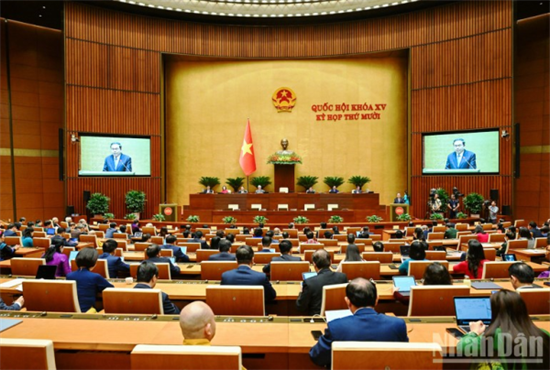 |
| The 15th NA’s 10th session (photo: nhandan.vn) |
The legitimacy of the NA refutes the rhetoric on “political pluralism and multiparty system”
With worn-out arguments, “pseudo-democrats” and hostile forces have constantly claimed that political pluralism and multiparty system are a prerequisite for democracy in Vietnamese society. Accordingly, they have demanded multiple political ideologies and regarded political pluralism as an expression of the “dynamism” of democracy in society.
By their insidious tactics, they have deliberately peddled political pluralism and multiparty system in order to sabotage the Communist Party of Vietnam (CPV), abolish our political regime, and steer the Vietnamese revolution towards the capitalist path. However, the legitimacy of the NA - the legislative body that has played a very important role in the country’s power system over the past 80 years - has refuted such distortions and inflammatory arguments.
Immediately after the success of the August Revolution in 1945, presiding over the Provisional Government’s first meeting, President Ho Chi Minh “proposed that the Government organise a GENERAL ELECTION under universal suffrage as soon as possible”. On 6 January 1946, the General Election was held to elect the NA; in November 1946, the first Constitution of our country was adopted by the NA, marking a historic turning point - our NA became a constituent assembly. As a result, political organisations and agencies of the people’s democratic state were officially established on a democratic basis, with firm legal validity, in conformity with Vietnam’s practical conditions, and in line with international legal practices. This affirmed the legitimacy of the revolutionary state of the people, by the people, and for the people, which was absolutely not the result of political pluralism, or multiparty system, or power struggle among political factions and parties.
In its history, the Vietnamese revolution has witnessed the emergence and existence of various political organisations. In 1945, during the early period of holding power and defending national independence, the Government headed by President Ho Chi Minh expanded its composition: in addition to the majority of Government members being CPV members, there were also members from other political parties and non-party individuals. After the election, the overwhelming majority of deputies to the 1st NA of the Democratic Republic of Vietnam were also CPV members, in addition to deputies from the Democratic Party, the Socialist Party, Viet Quoc, Viet Cach, as well as intellectuals and prominent individuals representing the great national unity bloc.
When Chiang Kai-shek’s troops withdrew, Viet Quoc and Viet Cach fled to China. At that time, only the CPV, the Democratic Party, and the Socialist Party remained in our country. Subsequently, the Democratic Party and the Socialist Party declared their self-dissolution. Thus, in our country there has been only one political party - the CPV as the ruling party. In fact, in certain historical periods, the NA included many different components, and the Government at times was a coalition, but it was politically monistic. Such political monism is manifested in the fact that the CPV is the sole ruling party, and that the sole development goal of the Vietnamese nation is national independence and socialism. This is an immutable value, leaving no room for political pluralism.
It can’t be denied that in Vietnam there exists no condition for political pluralism and multiparty system. In the past 80 years of its operation, the NA is a legislative organisation with representatives from all strata, sectors, and regions; however, it operates for the interests of the nation, embodying the principle that all power, including supreme power, belongs to the people. The sole operational goal of the NA is national independence, the people’s freedom, prosperity, and happiness, and a strong country standing shoulder to shoulder with the great powers of the five continents, together with the two centennial goals: “By 2030, Vietnam will become a developing country with modern industry and upper-middle income; By 2045, Vietnam will be a developed, high-income country”. This reality is undeniable.
A constructive NA allowing the people to exercise their right to mastery over the country
It must be affirmed that there is no need for political pluralism within a society in order to have democracy. Political pluralism and multiparty system are not universal values of humanity; they are not eternal values existing in all periods of a nation. Political pluralism and multiparty system may be suitable for one nation, but that does not mean they are a model for every nation. This demonstrates the diverse reality of political regimes around the world. Under its specific circumstances and development conditions, each nation has the right to choose its own goals and development path.
 |
| Adopting the Resolution on amending and supplementing several articles of the 2013 Constitution (photo: baochinhphu.vn) |
Our NA’s operation shows that there is no reason for Vietnam to adopt political pluralism and multiparty system. Regardless of any pretext, anyone who demands political pluralism and multiparty system in Vietnam is not only ill-intentioned and politically misguided, but also has extremely limited political competence. In reality, the quality of democracy in a society is absolutely not determined by the number of political parties. In the context of a socialist-oriented market economy and increasingly wide and deep international integration, the NA always respects, guarantees, and protects human rights, citizens’ rights and obligations, and the freedom and equality of all economic sectors in society. All of these things have been enshrined in the Constitution and institutionalised by law. During NA sessions, different opinions arising from pure motives, consistent with the Constitution and laws, and not going against Vietnam’s fine customs and traditions, are all received and accepted.
Moreover, democracy is closely linked to state institutions, with the NA being the clearest manifestation. President Ho Chi Minh affirmed that “Ours is a democratic country; the highest position belongs to the people as the people are the masters”, and that “Ours is a democratic regime, meaning the people are the masters”. Democracy always goes hand in hand with freedom. Accordingly, freedom is awareness and action in accordance with necessity. Necessity is an objective law of nature and society. Only when people recognise and act in accordance with that necessity can there be genuine freedom. There is no absolute freedom that disregards objective laws. President Ho Chi Minh pointed out: “Ours is a democratic regime; thought must be free. What is freedom? On every issue, everyone is free to express their opinions in order to contribute to finding the truth. That is both a right and an obligation of everyone. When everyone has expressed their opinions and the truth has been found, then freedom of thought becomes the freedom to submit to the truth. Truth is what benefits the Fatherland and people. Anything going against the interests of the Fatherland and people is not truth. To wholeheartedly serve the Fatherland and people is to submit to the truth”. Beyond common values, each nation has its own specific regulations; there is no absolute, universal model or standard.
Political pluralism and multiparty system do not definitely lead to freedom and democracy. In the world, there are many countries that follow the politically pluralistic, multiparty model, but their politics are unstable, their society is chaotic, and the people are not protected even in their most basic rights. Over the past 80 years, under the CPV’s leadership, our NA has demonstrated the constitutional and legal regulation, creating a legal corridor to govern all citizens’ conduct so as to achieve genuine freedom. Rejecting political pluralism and multiparty system is a principle of operation of the NA, which is both consistent with the country’s practical conditions and reflective of the political steadfastness and intellect of our entire CPV, people, and Military.
The NA’s question-and-answer activities contribute to raising the quality of guaranteeing and promoting democracy in society
Social criticism plays a crucial role in ensuring democracy in society in general, democracy within the CPV in particular. Democracy within the CPV is the foundation for democracy in society to be expanded and promoted. The level of democracy of the CPV is measured by the quality of institutions (its platforms, resolutions, statutes, and lines), the quality of its members, and the quality of practical leadership and direction. In addition to the Vietnam Fatherland Front, which has the function of social criticism, in many sessions of our NA, especially question-and-answer ones, members of the Government have clearly expressed opinions of a critical nature. This is a very important, effective channel of opinion, clearly demonstrating the people’s right to mastery in the legislative field. In the process towards the 14th National Party Congress, the NA held discussions and made significant contributions to the draft documents submitted to the Congress. Furthermore, our NA has created a solid legal basis to guarantee and promote social democracy. Within the mechanism in which “the Party leads, the State manages, the people are the masters”, our CPV exercises its leadership and governance on the basis of powers entrusted by the people; our State is a State of the people, by the people, and for the people; our NA plays a constructive role, and our people exercise their right to mastery with political awareness. These form a solid foundation for ensuring our country’s genuine democracy.
The NA is an integral part of the political system; political and social organisations in Vietnam are under the CPV’s leadership; this is inevitable, and this is absolutely not an imposition as hostile forces claim. On the contrary, proactively fostering innovation and improving the quality of activities towards the people, political and social organisations increasingly promote their role as an important channel of criticism, concretely reflecting the people’s problems and legitimate aspirations. This serves as an important basis for the NA’s legislative work and the Government’s policy-making, creating broad forums for the people to effectively exercise their right to mastery in all fields of social life.
In the past 80 years of operation, the NA of Vietnam has always demonstrated the central position of our people in state power. This reality proves that democracy in Vietnam and national development are not dependent on political pluralism or a multiparty system.
Prof. MACH QUANG THANG, PhD