
Building upon and further developing the substance of documents from previous Party Congresses, most notably the 13th National Party Congress, the Draft Documents to be submitted to the 14th National Congress of the Communist Party of Viet Nam (hereinafter referred to as the Draft) have been prepared with great care and rigour. They clearly demonstrate a strategic vision, together with profound innovations in theoretical thinking and in the Party’s leadership methods.
1. The theme of the 14th National Party Congress – the aspiration of the Vietnamese nation to rise
In the Draft, the theme of the 14th National Party Congress is concise (consisting of 66 words) and structured around four closely interlinked components. It comprehensively encapsulates the core issues, provides orientation for the country’s development path, and serves as a unifying foundation for mobilising and promoting the strength of the great national unity bloc, with a view to successfully realising the objectives and ideals in the years ahead.
The first component – the Party’s leadership role. The phrase “Under the glorious banner of the Party”, placed at the very beginning, powerfully affirms the central position and leadership role of the Communist Party of Viet Nam as the decisive factor in all victories of the Vietnamese revolution. The Party’s banner symbolises the will, mettle, intellect, and legitimacy of the working class and the Vietnamese working people. “Under the glorious banner of the Party” clearly embodies the principle of Party leadership, State management, and the People’s mastery. It reflects the People’s absolute trust in the Party, the spirit of nationwide solidarity, and a high level of social consensus to successfully carry forward the Party’s and the nation’s revolutionary cause on the journey towards a new era of development.
The second component – the sources of strength of the Vietnamese revolution. “Joining forces and acting in unity to successfully realise the country’s development goals to 2030” is a rallying call that evokes the spirit of great national unity. It reflects core traditional values and constitutes a powerful source of strength for translating the aspiration of national development into reality by 2030, a historic milestone marking the centenary of the founding of the Party. This represents a concrete expression of modern thinking: linking the socialist ideal with objectives for economic, cultural, social, and human development of Viet Nam in the new era.
The third component – the spirit of proactiveness, self-reliance, and self-strengthening. The phrase “strategic autonomy, self-reliance, and confident advancement in the era of the nation’s rise” affirms the country’s will and posture as it moves forward in the new era, embodying the independent, autonomous, and self-reliant character of Viet Nam, as well as the nation’s proactive, creative, and flexible approach to international integration. Strategic autonomy refers to the Party’s capacity and political mettle to independently determine development orientations, select partners, and choose modes of action, without external domination or influence. It is the ability to formulate and implement strategies in an independent and innovative manner, in line with domestic conditions and the international context. At the same time, it reflects the high level of intellectual capacity of the Party and the State in proactively forecasting, adapting to, and shaping national development strategies. Self-reliance, in essence, is the country’s capacity and determination to build its own forces and to consolidate and develop comprehensive strength in politics, the economy, national defence, culture, science, and other fields, thereby firmly safeguarding independence, sovereignty, unity, territorial integrity, and Vietnamese identity in the new era.
The fourth component – the ideals and ultimate destination of the Vietnamese revolution. “For peace, national independence, democracy, prosperity, affluence, civilisation, happiness, and steady progress towards socialism” is regarded as a political declaration that comprehensively reflects the strategic objectives of the Vietnamese revolution in the new era. It constitutes an integrated value system, expressing the unity between national goals, socialist ideals, and the interests of the People. Within this framework, “peace” and “independence” are the fundamental and indispensable conditions that ensure national sovereignty and self-determination; “the nation” and “democracy” affirm the People’s role as the true subjects of political life; “prosperity, affluence, civilisation, and happiness” represent the destination towards which all Party guidelines, State policies, and laws are directed, with the ultimate aim of serving the People, an expression of comprehensive national development that combines economic growth with social progress and equity. Finally, “steady progress towards socialism” embodies political resolve and affirms steadfast commitment to the objectives and ideals of the Vietnamese revolution, as chosen by the Party, President Ho Chi Minh, and the People.
In sum, the overall theme of the 14th National Party Congress carries profound political orientation and inspirational significance for action. It is not merely a slogan, but a political declaration, a national aspiration, and a strategic vision of the Party in the new era. It also reflects the dialectical relationship between ideals and practice, between long-term objectives and immediate tasks, and between the Party’s leadership and the strength of the People. This is the embodiment of the principle that “the People are the root”, crystallising the mettle, intellect, and aspirations of Viet Nam on its resolute path towards socialism.
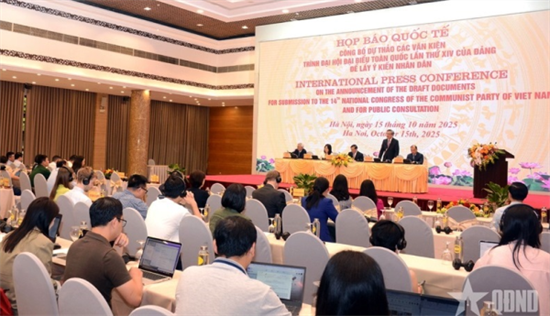 |
| Press conference on the publication of the Draft Political Report for public opinion |
2. The structure of the Political Report – innovative thinking and resolute action
Compared with the 13th National Party Congress, the draft Political Report to be submitted to the 14th National Congress of the Party demonstrates a number of notable innovations.
First, the Political Report is markedly concise, presented compactly and succinctly, with a high level of generalisation, clear focus, and well-defined priorities. It ensures strong action orientation and high feasibility in implementation. At the same time, it avoids duplication across documents, thereby enabling cadres, Party members, and the People to remember and grasp its contents with ease, while facilitating effective implementation by ministries, sectors, and localities.
Second, the integration of three major documents, including: the Political Report, the Socio-economic Report, and the Report on the Review of Party Building into a single Political Report submitted to the 14th National Congress constitutes a major breakthrough in the Party’s leadership thinking and governance methods. Political affairs, socio-economic development, and Party building are regarded as three organic components of a unified development whole; accordingly, such integration enhances coherence, consistency, and effectiveness in policy formulation, while avoiding overlap and fragmentation in leadership and direction. At the same time, it affirms the Party’s strategic vision in closely linking socio-economic development with Party building and rectification, thereby ensuring comprehensive and sustainable leadership. The Political Report is thus not merely a synthesising document, but also a strategic orientation for national development in the new era, clearly demonstrating the Party’s mettle, intellect, and modern leadership and governing capacity in response to the demands of renewal, international integration, and sustainable development towards 2030, with a vision to 2045.
Third, the overall structure of the draft Political Report to be submitted to the 14th National Congress of the Communist Party of Viet Nam largely retains the framework of the Political Report of the 13th Congress. However, a number of sections have been streamlined, reordered, and retitled to better reflect the position and role of each thematic area, the requirements of national development, and the Party’s viewpoints and policies already promulgated in those fields. For example, the section entitled “III – Continuing to build and comprehensively improve institutions for rapid and sustainable national development” was placed, in the Political Report of the 13th Congress, under “IV – Comprehensively and synchronously improving institutions for a socialist-oriented market economy”. This adjustment demonstrates the Party’s evolving thinking, from a primary focus on economic development towards an emphasis on the overall development of the nation. It clearly reflects the objective of building a modern, coherent institutional framework geared towards rapid and sustainable national development. Similarly, the section “V – Strongly and comprehensively developing Vietnamese culture and people” was positioned, in the Political Report of the 13th Congress, under “VII – Building and promoting cultural values and the strength of the Vietnamese people”. Whereas the 13th Congress emphasised consolidating, nurturing, and promoting existing values, the current draft reflects a shift towards a proactive, comprehensive, and modern development-oriented approach. This further affirms that culture and people are not only the spiritual foundation of society but also an endogenous driving force and the centre of the strategy for rapid and sustainable national development in the era of the nation’s rise. Viewed as a whole, the structure of the draft Political Report to be submitted to the 14th National Congress presents a clear and comprehensive picture of the tasks of the Vietnamese revolution in the forthcoming term.
3. The Action Programme of the Central Committee – a new advance in the Party’s leadership methods
For the first time, the Action Programme of the Central Committee has been prepared and brought forward for discussion directly at the Party Congress itself, representing a significant innovation in the Party’s leadership methods. In previous congresses, the newly elected Central Committee would formulate the Action Programme only after the resolution had been adopted. At the 14th National Congress, however, prior preparation and discussion at the Congress demonstrate a proactive, scientific leadership mindset with a strong focus on implementation. This marks a transition from the principle of “words matched by deeds” and from “formulating guidelines” to “ensuring the effective execution of resolutions”. At the same time, discussing the Action Programme at the Congress vividly reflects the spirit of democracy within the Party. Delegates, representing the intellect, will, and aspirations of the entire Party, the People, and the armed forces, are given the opportunity to directly deliberate, contribute opinions, and propose refinements, ensuring that the Action Programme is closely aligned with practical realities and possesses high feasibility. As a result, Party resolutions will not only provide political orientation but also be closely linked to concrete actions, responsive to the country’s development requirements.
Moreover, the adoption and approval of the Action Programme at the Congress itself enable implementation to be carried out in a coordinated and unified manner from the central level down to the grassroots, shortening the time required to concretise resolutions and ensuring their prompt translation into practice. This constitutes a vivid manifestation of innovation in leadership methods, enhancement of the Party’s leadership and governing capacity, and strengthening of its combativeness. It also reinforces the People’s confidence in the Party’s comprehensive leadership role at a time when “our country has truly entered a new era of development, the era of the nation’s rise, for a Viet Nam that is peaceful, independent, democratic, prosperous, affluent, civilised, and happy, steadfastly advancing towards socialism.”
Senior Colonel, PhD. NGUYEN VAN PHUONG, Institute of Military Social Sciences and Humanities