
The process of formation, development, and growth of the Organisation Department and the Military Party organisation sector has been closely associated with the history of combat, maturation, and victory of the Vietnam People’s Army. As a strategic advisory body on Party organisation and building work, the Organisation Department has made significant contributions to building a politically strong Army and a pure and strong Military Party Committee, thereby ensuring the Party’s absolute and direct leadership over the Army in all aspects throughout different revolutionary periods.
On 6 May 1946, President Ho Chi Minh signed Decree No.60/SL, renaming the “National Resistance Committee” as the “National Military Committee.” Article 5 of the Decree stipulated that the National Military Committee would comprise five agencies. Among them, the Political Department included the following sections: Office, Party Affairs, Propaganda and Training, Enemy Proselytisation, Military Justice, and Personnel. The establishment of the Party Affairs Section - the predecessor of today’s Organisation Department - marked a historic milestone, signifying the birth of the body responsible for organisation work across the entire Army and the Military Party organisation sector.
Over 80 years of construction, combat, and development, under the leadership and direction of the Central Military Commission, the Ministry of National Defence, and the General Political Department, and with the close coordination of party committees at all levels, generations of cadres and soldiers of the Organisation Department and the military Party organisation sector have consistently demonstrated firm political resolve and steadfast commitment to the goals of national independence and socialism; unity, creativity, and proactiveness in overcoming difficulties; and the capacity to provide timely, accurate, and effective advice while upholding principles. They have achieved numerous outstanding accomplishments in the performance of their duties, notably in the following areas:
Fully grasping its functions and tasks, the Organisation Department has proactively conducted research and provided advice to the General Political Department and the Central Military Commission for submission to the Party Central Committee, the Politburo, and the Secretariat, in order to concretise the Party Charter and to develop and refine the principles and mechanisms of Party leadership over the Military. This has aimed at maintaining and strengthening the Party’s absolute and direct leadership over the armed forces in all aspects throughout different revolutionary stages. It has also proposed the establishment of a system of organisational and operational principles for Party organisations within the Army, aligned with mission requirements in both wartime and peacetime, thereby ensuring that cadres, Party members, and the masses across the entire Army consistently demonstrate firm political resolve, high unity and cohesion, absolute loyalty, and unwavering confidence in the Party’s leadership, while steadfastly upholding combat objectives and remaining ready to undertake and successfully accomplish all assigned tasks.
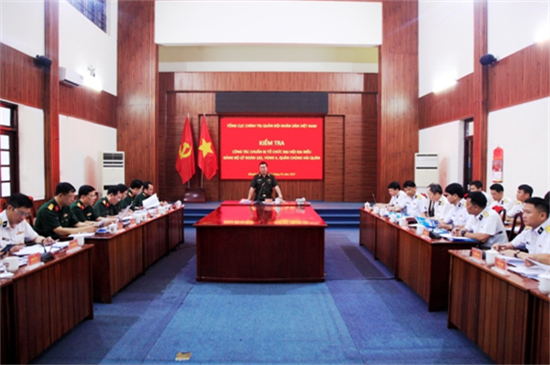 |
| Leader of the Organisation Department checks preparation work for Party Congress of Brigade 162 under Naval Region 4 (Photo: qdnd.vn) |
At the same time, the Organisation Department has proactively advised on the building and consolidation of the system of Party organisations, political agencies, and political cadres at all levels - from the Central Military Commission to grassroots units - in alignment with the organisation, structure, and missions of the Army. This ensures that wherever troops are stationed, Party and political work is effectively carried out. It has maintained strict adherence to Party organisational routines, regulations, and principles, particularly democratic centralism, self-criticism, and criticism, while actively innovating leadership methods and working styles. Furthermore, it has advised on and directed the launch of major movements during wartime, such as “Expanding democracy and strengthening discipline”, “Training Party members and rectifying Party organisations,” and “Building grassroots Party cells and organisations to meet ‘Four Good’ standards and ‘Seven requirements for Party member qualifications’,” as well as the policy of building company-level Party cells in line with new combat requirements. These efforts have contributed significantly to enhancing the leadership capacity and combat strength of Party committees and organisations at all levels.
The Organisation Department has advised and proposed to Party committees at all levels a wide range of leadership and directive measures for developing and building a contingent of Party members and cadres within the Army, ensuring strong continuity and meeting mission requirements. It has contributed to supplementing the ranks of Party members - tempered and matured through combat and practical work - for Party and State agencies as well as localities. Alongside advising the General Political Department and the Central Military Commission in mobilising millions of cadres, Party members, and the masses to serve the southern battlefield, the Organisation sector within the Military in general, and the Organisation Department in particular, dispatched hundreds of working groups and delegations to study battlefield conditions. Cadres of the Department were present across the B, C, and K theatres during the most difficult, arduous, and intense periods of the war; many made heroic sacrifices, while others achieved outstanding feats and later became senior leaders of the Party, the State, and the Army.
The Organisation Department and the Military Party organisation sector have advised, directed, and guided the implementation of Party and political work in a manner that is rich in content, flexible, creative, and highly effective across different types of units. These efforts have contributed to consolidating determination, maintaining combat morale, and enabling troops to overcome hardships and endure the rigours of warfare across all battlefields. At the same time, they have assisted Party committees, commanders, and political agencies at all levels in leading and directing the building and consolidation of mass organisations within agencies and units, ensuring that these organisations operate in accordance with their functions and tasks, thereby making an important contribution to building all-strong units and clean, strong Party organisations.
The Organisation Department has advised on and effectively implemented central resolutions and directives on Party building, in line with the practical conditions of the Military Party Organisation in the new revolutionary stage - particularly the Resolution of the 6th Plenum (Second Session) of the 8th Party Central Committee; the Resolution of the 4th Plenum of the 11th and 12th Party Central Committees; and Conclusion No.21-KL/TW dated 25 October 2021 of the 4th Plenum of the 13th Party Central Committee on intensifying Party building and rectification, and strengthening the political system. These efforts have been directed towards resolutely preventing, repelling, and strictly handling cadres and Party members exhibiting ideological, political, moral, and lifestyle degradation, as well as manifestations of “self-evolution” and “self-transformation.” In coordination with relevant agencies, the Organisation Department has also advised the General Political Department and the Central Military Commission in submitting to the Party Central Committee and the Politburo a range of leadership resolutions on military and defence work and on building the armed forces, in order to meet the requirements of the new situation. Notably, these include Resolution No.51-NQ/TW dated 20 July 2005 on “Further improving the Party’s leadership mechanism over the Army, implementing the single-commander system in conjunction with the commissar and junior system in the Vietnam People’s Army”; and Resolution No. 147-NQ/ĐU dated 4 April 2008 of the Central Military Party Committee on “Enhancing the leadership capacity and combat strength of grassroots Party organisations and improving the quality of cadres and Party members in the Army in the new period.” In addition, it has proposed and undertaken research and reviews of the Party’s leadership mechanisms over the Military and the cause of national defence; leadership mechanisms in building defensive zones; and the promulgation of regulations governing Party and political work in the new period.
With outstanding achievements over the past 80 years, the Organisation Department and the military Party building organisation sector have forged a proud tradition of “unity, steadfastness, proactiveness, and creativity”, and have been honoured with numerous prestigious awards conferred by the Party, the State, the military, and international partners.
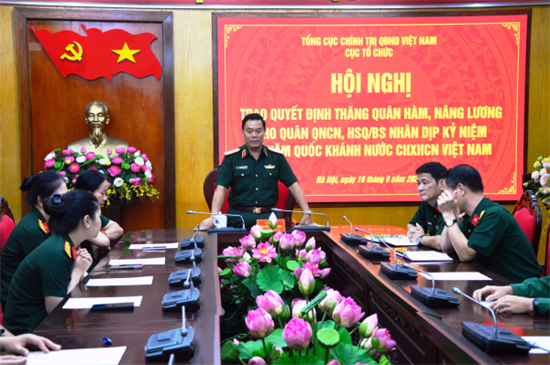 |
| Leader of the Organisation Department speaks at a promotion ceremony of its staff |
In the time ahead, to continue promoting their role in advising, directing, and guiding the building of clean and strong Party committees and organisations at all levels, continuously enhancing leadership capacity and combat strength, and building a politically strong Army, the Organisation Department and the military Party building organisation sector will continue to effectively implement the following key tasks:
First, to regularly and thoroughly grasp the resolutions and directives of the Party Central Committee on military and defence tasks and Party building; and to improve the quality of advisory, directive, and guiding work in Military Party organisation, as well as Party and political work across all missions. This includes closely adhering to military and defence tasks, and thoroughly implementing the Resolution of the 14th National Party Congress; the Resolution of the 12th Military Party Congress; Resolution No.44-NQ/TW dated 24 November 2023 of the 13th Party Central Committee on the Strategy for safeguarding the Fatherland in the new situation; Resolution No.21-NQ/TW dated 16 June 2022 of the 13th Party Central Committee on strengthening and consolidating grassroots Party organisations and improving the quality of Party members in the new period; the Resolution of the 4th Plenum of the 11th and 12th Party Central Committees; and Conclusion No.21-KL/TW dated 25 October 2021 of the 13th Party Central Committee on Party building and rectification, among others. These documents serve as the basis for effectively performing the function of research and strategic advisory in proposing policies and measures to build a clean and strong Party Organisation within the Army, capable of leading the successful implementation of military and defence tasks and safeguarding the Fatherland in the new situation.
Continuous efforts shall be made to advise, direct, guide, and inspect Party committees and organisations at all levels across the military in effectively carrying out Party organisation and building work, thereby contributing to maintaining and strengthening the Party’s absolute and direct leadership over the armed forces in all aspects. Participation in theoretical research and the practical review of Party building organisation work shall be further enhanced, with timely proposals to supplement and refine the Party’s leadership mechanisms and methods over the Army in line with the requirements of the new period.
Second, to place strong emphasis on building a clean and strong Party Organisation within the Organisation Department, ensuring the successful fulfilment of all assigned tasks and building a comprehensively strong “exemplary and typical” agency. Priority is given to strengthening Party committees and Party cells within divisions and sections in terms of political integrity, ideological firmness, ethical standards, organisational capacity, and personnel quality. Strict adherence shall be maintained to Party organisational routines and regulations, upholding the principles of democratic centralism, collective leadership combined with individual responsibility, as well as self-criticism and criticism. Internal unity and cohesion must be preserved, while efforts are intensified in managing, educating, and training Party members, maintaining close oversight of ideological developments and social relations. Strict compliance with discipline, laws, internal political security protection, and inspection and supervision of Party discipline enforcement must be ensured.
Efforts shall be strengthened to build the Organisation Department into a comprehensively strong, “exemplary and typical” agency, particularly in political terms; thoroughly grasping and effectively implementing the principles of “two steadfast commitments, two accelerations, two preventive measures, and five firmnesses” as directed by General Secretary To Lam, Secretary of the Central Military Commission, as well as the guidelines of “three excellences, three constructions, and three preventions”. Absolute vigilance must be maintained to prevent any manifestations of ideological, political, moral, or lifestyle degradation, as well as “self-evolution” and “self-transformation” within the organisation. Regular order and discipline shall be strengthened; administrative reform, the application of science and technology, and digital transformation shall be promoted; strict maintenance of routines in study, work, and daily activities shall be ensured; and working styles and methods shall be innovated towards greater practicality and effectiveness.
Third, to accelerate digital transformation and modernise methods of conducting the military Party building organisation work. The Organisation Department and the military Party building organisation and sector will continue to thoroughly grasp and effectively implement Resolution No.3488-NQ/QUTW dated 29 January 2025 of the Central Military Commission on breakthrough development in science and technology, innovation, and digital transformation in the Army; and Plan No.3832-KH/QUTW dated 16 May 2025 of the Standing Board of the Central Military Commission on implementing the digital transformation scheme in Party agencies within the Military Party Organisation. Priority shall be given to building and completing a comprehensive database system on Party organisations and Party members across the entire military in a centralised, unified, synchronised, and interconnected manner, ensuring accuracy and regular updates. This will provide a crucial foundation for enhancing the quality of management and evaluation of Party organisations and members, while effectively supporting research, forecasting, and strategic advisory work in Party building organisation. The development of such databases must ensure that data are “accurate, sufficient, clean, and dynamic,” with high capacity for exploitation, analysis, and integration, while maintaining strict standards of information safety, cybersecurity, and data protection.
Processes and working methods shall continue to be innovated towards digitalisation, standardisation, simplification, and the reduction of intermediate steps. The gradual transition to handling tasks in a digital environment shall be promoted, ensuring speed, accuracy, transparency, and clear traceability of accountability, thereby enhancing the effectiveness and efficiency of leadership, direction, and advisory work.
Fourth, to build a contingent of cadres engaged in organisation work within the Army with sufficient qualities and capabilities to meet the requirements of the new situation. Priority shall be given to developing a corps of organisational cadres with adequate quantity, high quality, and professional competence commensurate with assigned tasks. Emphasis is placed on building a team of cadres engaged in research, advisory, and direction of Party organisation and building work, as well as Party and political work, who possess comprehensive knowledge, deep professional expertise, and strong practical leadership capacity - particularly in research, problem identification, strategic advisory, forecasting, policy proposal, and guidance and supervision of implementation.
Due attention shall be given to training and professional development, combining in-service training and experiential knowledge transfer with formal education at academies and training institutions, as well as rotation and practical assignments at grassroots units. Cadres shall be encouraged to pursue self-study to enhance their comprehensive and specialised competencies, to innovate working methods, and to closely engage with grassroots realities in a practical, meticulous manner, in line with the spirit of “the seven dare-to’s.” At the same time, emphasis must be placed on developing digital competencies, digital skills, and adaptability to modern working environments, enabling organisational cadres to master technology and effectively exploit digital platforms in support of their professional duties.
Entering a new era of development, fully aware of their position and role, every cadre, staff member, and soldier of the Organisation Department and the Military Party organisation sector shall remain steadfast in upholding the Party’s line, viewpoints, and principles; closely adhere to the tasks and practical realities of building and combat of the Military; strengthen unity, proactiveness, and creativity; and actively engage in study and training to enhance awareness, responsibility, and professional competence. They are determined to excellently fulfil all assigned tasks, thereby further enriching the proud tradition of “unity, steadfastness, proactiveness, and creativity” of the Organisation Department and the Party organisation sector within the heroic Vietnam People’s Army.
Major General NGUYEN MINH LONG, Secretary of the Party Committee, Deputy Director of the Organisation Department