
Recognising the importance and significance of national defence and security education for students, the Centre for National Defence and Security Education at the University of Economics and Technology for Industries has been focusing on comprehensive development in terms of organisation, staff, lecturers, and infrastructure, aiming to contribute to building and developing a workforce that is both professionally competent and politically steadfast, serving the cause of national construction and defence.
Since its establishment in September 2021, the Centre for National Defence and Security Education of the University of Economics and Technology for Industries has implemented its tasks during its ongoing maturity in structure, staff, and facility.
Despite facing numerous difficulties, with proactiveness and determination, in the 2021 – 2025 period, the Centre successfully held 66 national defence and security education courses for roughly 24,000 students in strict observance of safety regulations, which is very positive and encouraging. However, to meet the requirements of a national defence and security education centre in the Red River Delta region, it is determined to continue to promote comprehensive and sustainable development, gradually improving the quality of training to meet the demands in the new situation.
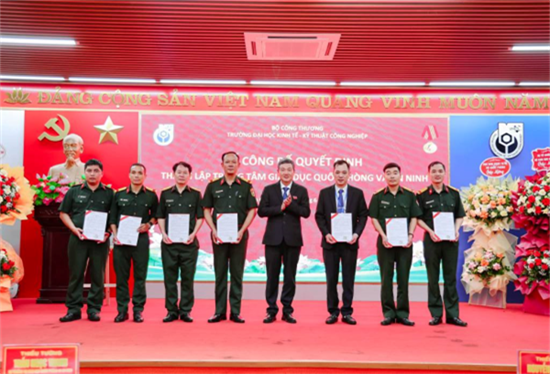 |
| The announcement of the establishment of the Centre at regional level |
Focusing on organisational restructuring, enhancing leadership and management capacity to meet the requirements of expanding training scale
After making the overall review of its organisation, personnel, facility, as well as the difficulties, the Centre has proactively advised and proposed to the Party Committee and the Board of Directors of the University to adjust, supplement, and perfect the Project “Building and developing the National Defence and Security Education Centre of the University of Economics and Technology for Industries in the period 2021 - 2030, with a vision to 2045”, which clearly defines the roadmap for developing its human resource and facilities to make it a model one in the Red River Delta region.
In the short term, it is to review, supplement, and adjust the regulations for leadership, management, and coordination among agencies and units. Empowerment and decentralisation will be exercised together with strengthening the accountability of Party committees and commanders at all levels for their task performance. Besides, it will strengthen political and ideological education to make sure that cadres, staff, and workers have sound understanding, consensus, and high level of agreement on the development policies and directions, so that they are to commit to their job and contribute to enhancing the Centre's position and prestige on par with its mission.
Developing a sufficient and standardised team of cadres and lecturers to meet both immediate and long-term mission requirements.
At present, 100% of the Centre's officers and lecturers hold bachelor degrees or higher (including approximately 17% with master's degrees), granted by military academies and schools, basically meeting immediate mission requirements. However, to meet the requirements of training 1,500 students per course, the Centre is determined to continue developing its staff sufficient in numbers, standardised in quality, with a rational structure, and a solid succession between generations, so that by 2030, over 40% of the officers and lecturers will hold postgraduate qualifications.
Based on that orientation, the Centre adheres closely to the prescribed organisational structure and staffing to clearly determine the necessary number and structure of personnel, serving as the ground for building a scientific and effective plan for recruitment, training, and utilisation. To make its staff sufficient in number, the Centre proactively advises the University to diversify recruitment sources with priorities being given to military officers who meet all standards in expertise and practical experience. In particular, for managerial and leadership positions, the Centre proposes prioritising the officers seconded from military units, aiming to leverage their strengths in organisational capacity, command, and training experience, contributing to improving the management and operational efficiency, and enhancing the quality of teaching and training.
To “standardise” the staff and lecturers, it continues to advise the Party Committee and Board of Directors of the University to select officers and lecturers for training courses at military and civilian educational institutions. Besides, it diversifies the methods of on-site training; maintain the regularity of teaching methodology improvement and evaluations; strengthen classroom observation and inspection; and frequently hold competitions and contests which will create both motivation and pressure for lecturers to improve their overall skills, knowledge, and abilities, especially for the young ones. In particular, it continues to research and advise the university to develop appropriate incentive mechanisms and policies to retain and attract personnel with good morality, strong professional skills, and dedication in work. This is considered a crucial factor for the stability and sustainable development of human resources, creating a foundation for gradually improving the quality of training to meet the requirements of teaching an increasingly large number of students in the future.
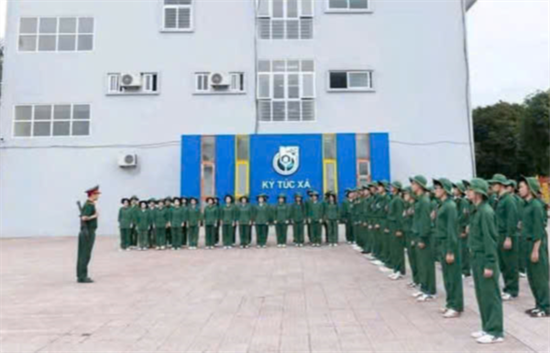 |
| Conducting drill training for students |
Improving the quality of training while strengthening student management and training
To realise the goal of building and developing the Centre into a model defence and security education institution in the Red River Delta region, its Board of Directors has identified the quality of student training and management as crucial factors in building its brand and reputation. First and foremost, the Centre strengthens the innovation of contents, programmes, and methods of teaching and learning towards standardisation, modernisation, and relevance to the target learners. In accordance with Circular No. 05/2020/TT-BGDĐT dated 18 March 2020, of the Ministry of Education and Training on the promulgation of the national defence and security education programme pedagogical colleges and higher educational institutions, the Centre actively reviews and updates the Party's viewpoints and policies, and the State's laws and regulations regarding national defence and security; incorporates new contents, such as non-traditional security and cybersecurity into its curricular, materials, and question banks in a consistent, scientific and relevant manner, thereby equipping students with a more comprehensive view of the task of national construction and defence in the current context.
Regarding teaching methods, the Centre focuses on innovation in a “learner-centred” approach, maximising student initiative and creativity. Lecturers are required to actively apply information technology, leverage electronic lesson plans, images, video materials, and 3D models to enhance visual appeal and stimulate learners’ interest. Classroom instruction, prompting, problem-solving, interaction and discussion are emphasised to encourage students’ self-learning and self-research. For practical training, instructors and administrators closely monitor the training process; provide timely guidance and correction to help students master the key principles and drills. In addition to the main curriculum, the Centre also holds several extracurricular activities, such as military games, sports competitions, cultural performances, and traditional seminars, contributing to strengthening team bonding, sharing, and self-disciplining. In addition, it also promotes the diversification of assessment methods to ensure objective and scientific evaluation, accurately reflecting the students' learning and training outcomes.
Together with improving teaching quality, the Centre continues to effectively implement the military-based model of managing and training students. The teaching staffs directly manage their students and strictly maintain regulations and discipline according to military rules, while grasping their thoughts and feelings to provide appropriate guidance and advice. Regulations regarding learning and living, policies, rights, and obligations of students during their studies are fully disseminated and posted on the University's website and internal communication channels so that students understand and implement rightly. At the same time, all legitimate concerns and aspirations of students are listened to and addressed opportunely during their time at the Centre.
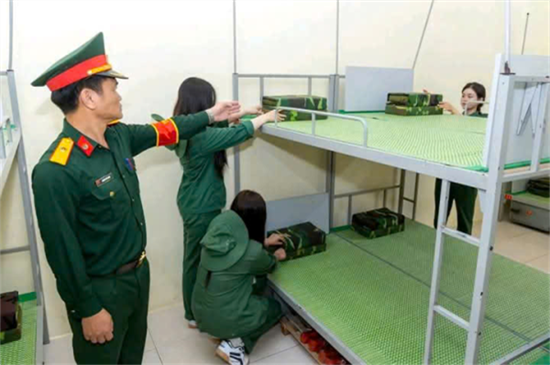 |
| Checking the living condition of students |
Developing synchronised and modern facilities to create a foundation for sustainable development
To meet the requirements of expanding the scale of training, given its limited budget, the Centre proactively balances resources to gradually upgrade its infrastructure and facilities, purchase teaching models and equipment, ensuring the best conditions for teaching, learning and living of students; strengthens management and effectively utilise the existing facilities, build a rational and flexible usage plan to optimise their functionality and suit actual conditions. In the long term, along with leveraging the allocated budget and resources from the University, it focuses on developing information technology infrastructure, gradually applying software into the management and operation of training. Simultaneously, investments are to be made in housing, dining halls, lecture halls, digital libraries, etc., to meet the needs of roughly 1,500 students per year. Besides, it will strengthen education to enhance the responsibility among staff, lecturers, and students in managing and using weapons, teaching and learning equipment in a safe and effective manner, thereby contributing to gradually building increasingly standardised and modern facilities, meeting the requirements of development in the new phase.
Last but not least, the Centre continues to closely coordinate with affiliated educational institutions, agencies and units in the area, and local authorities in information and experience sharing, and coordinating and collaborating in teaching and learning activities to harness a synergy for building a comprehensively developed Centre, commensurate with its mission and a reliable place to nurture and cultivate patriotism for the young generations, contributing to building and defending the Fatherland in the new situation.
Ms. NGUYEN NGOC HUU, Deputy Director of the Centre