
The 14th National Party Congress continues to affirm that institutional improvement is one of the three strategic breakthroughs. In this regard, improving the political institution is a key issue to enable Vietnam to develop rapidly and sustainably in the new era, towards a socialist-oriented developed country with high income by 2045.
Within the structure of a social regime, there exists a comprehensive system of institutions: economic, political, cultural, social, etc. Among them, the political institution is the system of organisations, regulations, laws and structures that a nation uses to manage and govern society in accordance with certain political objectives. The political institution in our country is a socialist political institution, including the Communist Party of Vietnam (CPV), the State of the Socialist Republic of Vietnam, the Vietnam Fatherland Front (VFF) and its member political - social organisations, social organisations, etc., together with the legal system (the Constitution and laws).
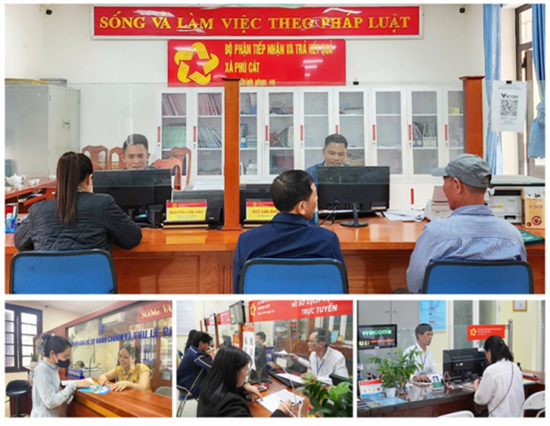 |
| A commune-level public service system (photo: baochinhphu.vn) |
Throughout the process of leading the revolution, particularly in the cause of national renovation (Doi Moi), our Party has always paid attention to building and gradually improving the political institution, considering this one of the strategic breakthrough objectives. In the process, the institution of Party leadership has increasingly been improved; the institution promoting the State’s role and regulating the relationship between the market and society has been more clearly defined. This is one of the decisive factors in the success of the Doi Moi cause, allowing the country to keep achieving “very significant, comprehensive results, with many outstanding highlights”. National independence and sovereignty as well as a peaceful environment have been maintained; political and social stability has been ensured; the economy has continued to grow; national defence and security have been consolidated; the people’s living standards have improved considerably; the country’s position and international prestige have been increasingly enhanced.
However, the process of improving our political institution remains slow and in some aspects has not met the requirements of revolutionary tasks in the new stage yet; it has even become a “bottleneck of bottlenecks”. “Some laws, mechanisms, policies, regulations, and administrative procedures remain contradictory, overlapping, and inconsistent, creating obstacles to development”. Therefore, at its 14th National Congress, our Party continued to affirm that building and synchronously improving development institutions is a central task of long-term strategic significance. The CPV emphasised that “improving the political institution is a key issue aimed at maintaining political and social stability, promptly removing ‘bottlenecks’ and ‘knots’, unlocking all resources for rapid, sustainable development, enhancing the efficiency and effectiveness of state management, promoting innovation and digital transformation, elevating national competitiveness, protecting the people’s legitimate rights and interests, and building a peaceful, unified, prosperous, strong, democratic, equitable, civilised, happy Vietnam”.
To that end, we need to continue improving the operating mechanism of the political system under the principle: “the Party leads - the State manages - the people are the masters”, thereby ensuring that “the people are the root”, the subject of political power, state power, and political relations, especially relations with the Party, the State, the VFF and its member political - social organisations. In essence, this aims to gradually perfect socialist democracy, promote the people’s dynamism, creativity, willpower, and aspiration for building a prosperous, civilised, happy country, create new driving forces and social consensus, and keep strengthening the great national unity bloc in the cause of national construction and defence.
Accordingly, first of all, it is necessary to continue improving the institution of Party leadership. The CPV is a ruling party and at the same time the subject exercising leadership over political power and state power within the socialist political system. The Party’s leadership over the State and society is a vital principle of our political institution, enshrined in Article 4 of the 2013 Constitution of the Socialist Republic of Vietnam, and it must absolutely not be underestimated or denied. 40 years of comprehensive, synchronous Doi Moi have proven that “the Party’s leadership is the fundamental factor determining every victory of the Vietnamese revolution”. Hence, in order to improve the institution of Party leadership, it is vital to continue to strongly renew the Party’s leadership and ruling methods and enhance the CPV’s leadership capacity and combativeness.
 |
| Serving the people is a duty and pride of every official (photo: baochinhphu.vn) |
To that end, it is necessary to keep thoroughly grasping and implementing Ho Chi Minh’s thought: “our Party must be truly moral and civilised”, focusing on building a pure and strong CPV in all aspects: politics, ideology, morality, organisation, and personnel, strengthening the fight against corruption, wastefulness, and negative phenomena in an effective manner. Due attention should be paid to supplementing and improving the Party’s leadership and ruling methods, further institutionalising the relationship in which “the Party leads - the State manages - the people are the masters”, especially the relationship between the Party and the State. At the same time, the Party’s leadership methods through documents should be strongly renewed by shifting from policy thinking to action thinking and decisive action, from “speaking correctly” to “doing effectively”, by issuing resolutions that are concise, easy to understand, easy to remember, and easy to implement, by promoting the role, responsibility, exemplary conduct, and “seven dares” spirit of party committees, party organisations, and leaders at all levels, by developing leadership and working regulations of party committees and organisations at all levels that are tight, scientific, specific, and close to reality and seriously implementing those regulations.
Second, improving the state institution from “management and administration” to “governance, facilitation, action, and development”. This is a breakthrough mindset and a central task in improving the political institution as identified by the 14th National Party Congress. The socialist rule-of-law State of Vietnam is the “pillar” and the centre of the political institution. Therefore, improving the institution of a state of governance, facilitation, action, and development requires continuing to perfect mechanisms for coordination and control among state agencies (legislative, executive, and judicial), ensuring that power will be unified and interests will belong to the people, truly making it a socialist rule-of-law State of the people, by the people, and for the people, led by the CPV. It is important to build the National Assembly truly as the highest representative body for the will, aspirations, and power of the people, and develop a synchronised, complete, unified, transparent, feasible, and development-oriented legal system serving the people. Great value should be attached to reviewing and improving regulations on the organisational apparatus of ministries, ministerial-level agencies under the Government, and two-tier local governments, building a modern, integrated public administration and public service system that operates transparently, effectively, efficiently, remains close to the people, and serves the people. The functions, tasks, and operations of the system of People’s Courts and People’s Procuracies should be improved; legal institutions and judicial support mechanisms should be perfected in order to build a professional, modern, fair, strict, upright judicial system serving the Fatherland and the people. A modern, effective national governance system should also be built, while scientific, reasonable decentralisation, delegation, and authorisation in line with national and local conditions should be promoted.
Third, improving the institution for controlling political power and state power. The socialist political institution in our country is a democratic one in which political power and state power belong to the people and are entrusted by them to representative state agencies. Accordingly, improving our political institution must involve improving the institution for controlling power, with a focus on mechanisms for controlling political power and state power to ensure that power is exercised properly and does not become “degenerated”. This is both a matter of principle and a guarantee of the nature of our socialist political institution. One of the basic characteristics of political power and state power is that they are very easily “degenerate”. If they are not tightly, scientifically controlled, such degeneration can alter the nature of the political regime and even lead to its collapse. The late General Secretary Nguyen Phu Trong emphasised that “power must be locked in a cage of institutions”. Thus, in order to improve power-control institutions in our country, it is vital to concentrate on perfecting mechanisms for power control within the state apparatus, within party organisations, and among party members, and improving methods for power control from party organisations, the VFF and its member political - social organisations, the press, and the people. These mechanisms are highly practical and effective, and therefore regulations should be improved to enhance social supervision and public criticism.
Fourth, improving institutions for preventing and combating corruption, wastefulness, and negative phenomena in order to purify the political system. Fighting corruption, wastefulness, and negative phenomena is a consistent policy and strong political determination of our Party; it is a requirement of Doi Moi and national development and also the demand, trust, and expectation of the people. For the sake of improvement in our political institution, it is necessary to continue improving institutions for preventing and combating corruption, wastefulness, and negative phenomena, thus purifying the political system. Institutions for preventing and combating corruption, wastefulness, and negative phenomena, together with ethical standards in various fields of social life and mechanisms for controlling power, are fundamental and foundational factors capable of preventing corruption, wastefulness and negative behaviours from their root causes. Therefore, on the basis of thoroughly grasping the Party’s guiding viewpoint that prevention is fundamental and long-term while combating must be resolute, with no forbidden zones and no exceptions regardless of who is involved and without being subject to pressure from any organisation or individual, under the motto of conducting the struggle “continuously and without pause”, “handling one case to warn an entire region or sector”, following the direction of General Secretary To Lam: “Perseverance - Determination - Consensus - Comprehensiveness - Breakthrough”, it is important to continue improving preventive mechanisms to ensure that cadres “cannot”, “do not dare”, “do not want”, and “do not need” to engage in corruption, negative behaviour, or wastefulness. Consideration should be given to continuing to improve the functions, tasks, and operations of the Central Steering Committee for Prevention and Combat of Corruption, Wastefulness, and Negative Phenomena and provincial-level steering committees. Emphasis should be placed on dealing with inadequacies in party regulations and legal provisions. Mechanisms for party inspection and supervision, as well as state inspection and auditing, should be perfected to prevent corruption, wastefulness, and negative phenomena from arising; an index system for evaluating the effectiveness of anti-corruption work should be completed soon and applied uniformly nationwide. Mechanisms and regulations should also be perfected to ensure effective investigation, prosecution, trial, and enforcement of judgements relating to corruption, wastefulness, and negative phenomenon cases, thus contributing to purifying the contingent of cadres within the political system.
Improving the political institution is one of the strategic breakthroughs and a key issue for enabling the country to develop rapidly and sustainably in the new era, as emphasised by our Party in the Documents of the 14th National Congress, demonstrating the CPV’s consistent thinking and strategic vision. Thoroughly grasping and effectively implementing the CPV’s standpoint is the responsibility of the entire Party, the entire people, the entire Military, and the entire political system, creating new momentum to bring the country towards prosperity, civilisation, happiness, and socialism.
Sr. Col., Associate Prof. NGUYEN SY HOA, PhD
Army Academy